
Add Comments to Shopify Sites
FastComments is available on the Shopify App Store. Install the app and drop FastComments blocks onto any blog post, product page, or custom page from the Shopify theme editor. No code editing required.
When you install the app, Shopify provisions your FastComments account, wires up your store domain, and connects billing automatically. You do not need to sign up at fastcomments.com separately.
The pages in this guide cover each FastComments block the app provides, how single sign-on works for your Shopify customers, and how to import existing Shopify comments before switching over.
Install the FastComments App 
Install from the Shopify App Store
- Open the FastComments listing on the Shopify App Store.
- Click Add app and pick the plan you want during the install flow.
- Shopify redirects you back into the FastComments admin inside Shopify when the install completes.
That's the full install. There is nothing to paste into your theme files.
What gets set up for you
The install runs everything you would otherwise do by hand:
- A FastComments tenant is created for your store and linked to your shop domain.
- Your shop's store URL is added to the tenant's authorized domains, so comments load without a domain error.
- A
fastcomments.tenant_idshop metafield is written so every block knows which tenant to render against. - Single sign-on for your Shopify customers is enabled by default.
- Billing runs through Shopify Managed Pricing. Charges appear on your regular Shopify bill. Upgrade, downgrade, or cancel from Settings > Apps and sales channels > FastComments in your Shopify admin.
If your shop was already a FastComments customer before you installed the app, the install reuses the existing tenant instead of creating a new one.
The embedded admin
When you open the FastComments app from your Shopify admin, you land on a dashboard with one-click tiles into the full FastComments backend:
- Dashboard: account settings, usage, and subscription details.
- Moderation Queue: approve, reject, and reply to comments across your store.
- Customize: adjust widget colors, fonts, moderation rules, and configuration.
- Ratings & Reviews Helper: set up star ratings and review questions if you want to use the Reviews Summary block.
Each tile opens FastComments with a single-use login link, so you don't need a separate sign-in.
Next: add blocks to your store
Open your Shopify theme editor (Online Store > Themes > Customize), open the template you want to add commenting or reviews to, and click Add block. The FastComments blocks appear under Apps. The rest of this guide covers each one.
Add Comments to Blog Posts and Products
The FastComments block is the main commenting widget. Add it to blog post templates, product templates, or any other page where you want a discussion thread or a live chat.
Add the block
- Open the Shopify theme editor (Online Store > Themes > Customize).
- Pick the template you want comments on: Blog post, Product, or any other page or section template.
- In the section where you want comments to appear, click Add block.
- Under Apps, select FastComments.
- Click Save.
The block appears immediately. There is no Tenant ID to enter; your store's tenant is wired up automatically when you install the app.
Settings
| Setting | What it does | Default |
|---|---|---|
| Tenant ID (optional) | Override which FastComments tenant the block renders against. Leave blank to use the store's automatically-configured tenant. Find a manual tenant ID at fastcomments.com/auth/my-account/api-secret. | (blank) |
| SSO | Auto-logs the visitor in as their Shopify customer account before commenting. See Auto-Login Shopify Customers. | On |
| Commenting Style | Threaded for nested replies and votes, or Streaming for a real-time chat feed. | Threaded |
| Custom URL ID | Override the auto-detected page identifier. Use this when you want two URLs to share one comment thread. | (auto-detected) |
How the page identifier is chosen
Each comment thread is keyed by a URL ID. The block picks one automatically:
- Blog post template:
shopify-article-{article.id}, which is stable across slug and title changes. - Product template:
shopify-product-{product.id}, which is stable across slug and title changes. - Other templates: the request path.
If you set Custom URL ID, that value is used instead. Use the same Custom URL ID across multiple blocks (for example, on a localized variant of a product page) to share one comment thread.
Threaded vs Streaming
Threaded is the default. Visitors reply to each other, vote, and moderation tools work as expected. Best for blog posts and product reviews.
Streaming drops the threading and shows new comments in real time as they're posted, like a chat feed. Best for product launches, live events, and community pages.
Multiple blocks on the same page
The block can be added more than once to the same template. For example, a Reviews Summary at the top of a product page and a FastComments block at the bottom. The blocks share a URL ID, so the summary reflects the comments below.
Tips
- The block hides itself in the theme editor preview with a yellow notice if it can't find a tenant. If that appears in your live store, reinstall the FastComments app.
- For a product page, the FastComments block doubles as your product reviews widget. Pair it with FastComments - Reviews Summary for a star-rating summary at the top of the page.
Add a Comment Count Badge
The FastComments - Comment Count block renders a small comment count for a single page. Use it in blog post lists, product cards, or any template that links to a page with comments, so visitors can see how active each thread is before clicking through.
Add the block
- Open the Shopify theme editor.
- Open the template where you want the count to appear. For example, the Blog template (the post list) or a product listing section.
- Click Add block in the section that renders each item.
- Under Apps, select FastComments - Comment Count.
- Click Save.
Settings
| Setting | What it does | Default |
|---|---|---|
| Tenant ID (optional) | Override which FastComments tenant the count reads from. Leave blank to use the store's automatically-configured tenant. | (blank) |
| Custom URL ID | Override the page identifier the count looks up. Use this when the count is on a different page from the FastComments block it tracks. | (auto-detected) |
How the count matches the comment thread
The Comment Count block uses the same auto-detection logic as the FastComments block:
- Blog post template:
shopify-article-{article.id} - Product template:
shopify-product-{product.id} - Other templates: the request path
If you set a Custom URL ID on the FastComments block on a page, set the same Custom URL ID on the Comment Count block so they point at the same thread.
Tips
- Counts for every item on the page are fetched in one request, so adding the block to every item in a long list has no extra round-trip cost.
- One Comment Count block per article or product in a listing is the expected usage; the block can be added as many times as you need.
Add a Recent Comments Feed
The FastComments - Recent Comments block shows the most recent comments across your whole store. Use it to show fresh activity in a sidebar, footer, or homepage section.
Add the block
- Open the Shopify theme editor.
- Open the template where you want the feed. A sidebar section, the home page, or the blog index all work well.
- Click Add block in the section that should hold it.
- Under Apps, select FastComments - Recent Comments.
- Click Save.
Settings
| Setting | What it does | Default |
|---|---|---|
| Tenant ID (optional) | Override which FastComments tenant the feed reads from. Leave blank to use the store's automatically-configured tenant. | (blank) |
| Number of comments | How many recent comments to show. Range 1 to 50. | 5 |
Tips
- Each comment links to the page it was posted on, so the block doubles as a "what people are talking about right now" navigation hint.
- The feed is store-wide. To show recent comments for a single page, use the FastComments block on that page instead.
Add a Recent Discussions Feed
The FastComments - Recent Discussions block lists the pages on your store with the most recent comment activity, one entry per page. Use it when you want visitors to discover active threads rather than individual comments.
Add the block
- Open the Shopify theme editor.
- Open the template where you want the feed, such as a sidebar, footer, blog index, or homepage section.
- Click Add block in the section that should hold it.
- Under Apps, select FastComments - Recent Discussions.
- Click Save.
Settings
| Setting | What it does | Default |
|---|---|---|
| Tenant ID (optional) | Override which FastComments tenant the feed reads from. Leave blank to use the store's automatically-configured tenant. | (blank) |
| Number of comments | How many recent discussions to show. Range 1 to 50. | 20 |
Recent Discussions vs Recent Comments
Both blocks pull from the same data, but they show different views:
- Recent Comments: a flat list of the latest individual comments. Best for "what was just said".
- Recent Discussions: one entry per page, ordered by most recent activity. Best for "which threads are alive right now".
You can use both on the same store. For example, Recent Comments in the blog sidebar and Recent Discussions on the home page.
Add a Top Pages List
The FastComments - Top Pages block lists the pages on your store with the most comment activity overall. Use it to surface your most-discussed posts or products.
Add the block
- Open the Shopify theme editor.
- Open the template where you want the list, such as a sidebar, footer, or blog index section.
- Click Add block in the section that should hold it.
- Under Apps, select FastComments - Top Pages.
- Click Save.
Settings
| Setting | What it does | Default |
|---|---|---|
| Tenant ID (optional) | Override which FastComments tenant the list reads from. Leave blank to use the store's automatically-configured tenant. | (blank) |
Top Pages vs Recent Discussions
- Top Pages ranks by total engagement, so the same posts tend to stay near the top for a while. Good for a "popular posts" sidebar.
- Recent Discussions ranks by most recent activity, so the list churns. Good for a "what's hot right now" panel.
Add a Reviews Summary
The FastComments - Reviews Summary block shows an aggregated star rating and review breakdown for a page. Pair it with the FastComments block on product templates for the standard reviews layout: summary up top, review form and reviews below.
Prerequisite: set up Ratings & Reviews
The Reviews Summary block displays the rating questions you configured for your store. Set those up first:
- Open the FastComments app in your Shopify admin.
- Click the Ratings & Reviews Helper tile (or open Ratings & Reviews Helper directly).
- Add the questions you want each reviewer to answer (overall star rating, "how was the fit", etc.).
Without questions configured, the summary block has nothing to aggregate.
Add the block
- Open the Shopify theme editor.
- Open the Product template (or the page template where you want the summary).
- Click Add block near the top of the page section, above where the FastComments block will be.
- Under Apps, select FastComments - Reviews Summary.
- Add a FastComments block lower on the same page if you haven't already, so visitors can leave reviews.
- Click Save.
Settings
| Setting | What it does | Default |
|---|---|---|
| Tenant ID (optional) | Override which FastComments tenant the summary reads from. Leave blank to use the store's automatically-configured tenant. | (blank) |
| Custom URL ID | Override the page identifier the summary aggregates against. Use this when the summary lives on a different page from the FastComments block it reflects. | (auto-detected) |
How the summary matches the reviews
The Reviews Summary block uses the same auto-detection logic as the FastComments block:
- Product template:
shopify-product-{product.id} - Blog post template:
shopify-article-{article.id} - Other templates: the request path
For a normal product page, the summary and the comment thread share a URL ID automatically, with no configuration needed.
Tips
- The summary is read-only. To collect reviews, you need a FastComments block on the same page.
- If you change rating questions in Ratings & Reviews Helper after collecting reviews, the summary recalculates against the new question set.
Auto-Login Shopify Customers
The FastComments block supports single sign-on so your Shopify customers can comment as themselves without creating a separate FastComments account.
How it works
When a visitor who is logged into your store opens a page with the FastComments block:
- The block detects the Shopify
customerobject. - It sends the customer's name and email to FastComments through a signed app proxy request.
- FastComments creates or matches a user keyed by
shopify-{customerId}, so the same customer always maps to the same FastComments user across sessions and re-installs. - The visitor's name shows up on their comments. They are not prompted to log in again.
If the visitor is not logged into the store, the block falls back to anonymous commenting (or the FastComments sign-in flow, depending on your widget configuration).
Turning SSO off
SSO is on by default for every FastComments block. To turn it off on a specific block:
- Open the Shopify theme editor.
- Open the template that contains the block and click the block to select it.
- Uncheck SSO.
- Click Save.
Turn SSO off if you want commenters to choose a separate identity for the conversation. For example, an internal community page where staff comment under a different display name.
What FastComments receives
The SSO payload sent for each customer contains:
- A user ID derived from the Shopify customer ID (
shopify-{customerId}). - The customer's email (used to identify the user; not displayed publicly).
- The customer's display name (used as their comment author name).
No order history, payment, or address data is sent. The payload is signed server-side; the customer's browser never sees a credential.
Login and logout links
When SSO is on, the comment widget's sign-in and sign-out links point at /account/login and /account/logout, the standard Shopify customer account routes. There is nothing to configure. The links work for any store with customer accounts enabled.
Import Existing Comments
If you already have comments on your Shopify blog posts and want to keep them, import them into FastComments before you disable Shopify's native commenting.
The import has to run while Shopify's native comments are still active and visible. Once you disable them, FastComments can no longer read them.
How to start an import
- Make sure the FastComments app is installed on your store.
- Leave Shopify's native commenting enabled for now.
- Open a support ticket and tell us which blogs to import.
The import runs in less than a day.
Once your existing comments are in FastComments, add the FastComments block to your blog post template and remove or disable Shopify's native comments. See Add Comments to Blog Posts and Products.
If you don't need to keep existing comments, you can skip this page.
Customization
Colors, fonts, moderation rules, allowed HTML, and anonymous commenting are all configurable to match your store's branding.
Open the FastComments app in your Shopify admin and click the Customize tile to open the widget customization screen. It uses a single-use login link, so you don't need a separate sign-in.
For the full list of customization options, see the Customizations and Configuration guide.
Domain Errors
If you installed FastComments from the Shopify App Store, your shop domain is added to the tenant's authorized domains automatically and you should not see a domain error. This page applies if you went through the manual install path, or if your storefront is served on a custom domain that wasn't registered with Shopify at the time the app installed.
You may get an authorization error that looks like this:
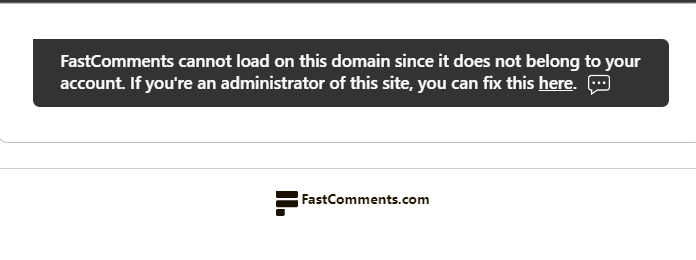
This means FastComments doesn't recognize the domain the widget is loading on as authorized for your tenant.
To fix it, add the domain to your FastComments account: Configure Domains.
Manual Install (Advanced)
If you can't install the Shopify App Store app, you can still add FastComments by editing your theme. This path is useful when you want to wire up a FastComments tenant you already own, or when you're embedding on a Shopify storefront where the app isn't an option.
The app-based install is the supported path for most stores. Reach for this only if the app doesn't fit.
Step 1: Disable Shopify's native comments
In your Shopify admin, go to Blog posts > Manage blogs, open each blog, and set Comments are disabled in the right-hand panel. Save.
This stops Shopify's built-in commenting from showing alongside FastComments.
Step 2: Open the blog theme template
In your Shopify admin:
- Go to Online Store > Themes.
- Under your current theme, click Actions > Edit code.
- In the file browser on the left, open Sections and click
main-article.liquid.
This is the template Shopify renders for a single blog article.
Step 3: Paste the FastComments snippet
Scroll to roughly line 100 of main-article.liquid, just after the closing </div> of the article body. Paste the following snippet:

Replace "demo" with your own Tenant ID from fastcomments.com/auth/my-account/api-secret. Click Save.
Step 4: Authorize your shop domain
Open a blog post on your live store. If you see an authorization error instead of the comment widget, FastComments needs to know your store is allowed to use this tenant. See Domain Errors.
Adding FastComments to other pages
The same snippet works on any Liquid template, including product pages, custom pages, and the home page. Paste it where you want comments to appear and adjust urlId if you want a stable identifier per page (for example, urlId: "{{ product.id }}" on a product template).